This essay has spoilers for all of the Attack on Titan manga, including the ending.
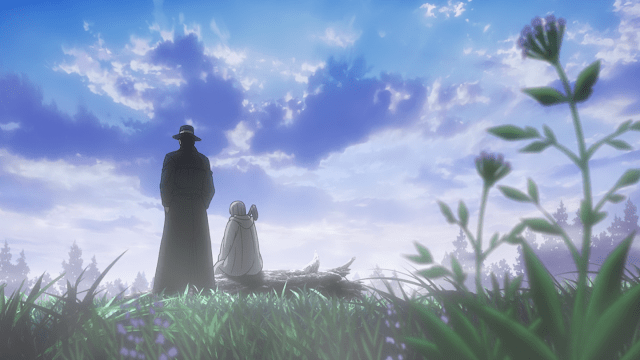
“They couldn’t keep going…
Unless they were drunk on something.
They were all… slaves to something…
Even him…”
-Kenny, ch. 69
Cohesion is an often overlooked aspect of storytelling. There’s nothing wrong with just telling an entertaining or interesting story, but what about consistency? It’s no secret that writing a good story is hard, but I believe writing a good story that’s cohesive is even harder. After all, if a story and its characters change as they progress, and in certain cases, that story is written over the course of several years, it’s to be expected that the narrative, as in what the author is trying to communicate to the audience through the story, will change over time as well.
Despite radically shifting in scope and focus over the course of the series, Attack on Titan is one of the most cohesive stories I’ve ever experienced. Many of the same themes and ideas explored at the beginning of the story continue to be explored by the very end, just in different ways and from different perspectives. The writing is so consistent and carefully crafted in so many ways that it can often feel overwhelming trying to pin it all down. It’s the kind of story where it’s practically guaranteed you won’t pick up on every detail on a first read or watch.
Some are obvious, like the concept of freedom, a core tenet of AoT’s plot and narrative which is explored thoroughly in many ways throughout the story. Some are a bit less obvious, but are still just as important to understanding what AoT has to say about humanity.
Some examples are the concept of the dream, metaphorical drunkenness, and the theme of letting go, seemingly separate ideas that are actually inseparable in AoT. Most of the cast represent these ideas in different ways, and while I do intend to keep the door open for potential writing on them in the future, I want to first focus on Kenny Ackerman, a character who not only explores these ideas, but embodies them to such an extent that the story and its themes would be incomplete without him. Kenny is also crucial to understanding many of the other characters, their actions throughout the plot, and the ending. Despite having an active role in the story for a relatively short amount of time, Kenny is one of the most important characters in all of Attack on Titan.
- Was It Violence?

Understanding why Kenny is so significant to AoT first requires understanding of his background and mentality. While Kenny’s past before he became a serial killer is never divulged, it can be inferred that his upbringing was not a kind or comfortable one, due to living in the crime and poverty-ridden Underground, as well as the government’s persecution of the Ackermans. It’s no surprise that violence was all he had ever known or believed in, made even worse by having superhuman Ackerman strength to take advantage of.
Yet Kenny’s self loathing stopped him from ever being truly satisfied with the life he led. Even if Uri hadn’t literally held him in the palm of his hand that day, I’m sure he never would have found happiness aimlessly murdering MP’s for the rest of his life. His line of never particularly caring about the Ackerman’s grudge toward the monarchy is telling of his lack of purpose in life. Strength enabled his violent lifestyle, but it never brought him fulfillment. His mask of power and violence was a farce.
Of course, when Uri Reiss gripped Kenny in the hand of his Titan, seconds away from squeezing out his insides, Kenny’s façade crumbled. Never having even seen a Titan before, Kenny was powerless in the face of someone stronger than him. Yet someone that powerful not only spared him- he prostrated himself, begging for forgiveness. What was it that could have driven him to do that? What was it that stopped their mutual paths of destruction from intersecting that day? Kenny would not find the answer for years to come, not until it was far too late.
Despite joining the Military Police, Kenny never cared about serving the monarchy. He had one thing and one thing only that pushed him forward; his dream. Uri was arguably the most powerful person within the Walls, yet he had shown mercy to a piece of garbage like Kenny. Was it his power that allowed him to be kind? Could Kenny see the same things as Uri, if he was that powerful?
And so Kenny’s dream was born, a dream of absolute power that could grant absolute compassion, power that would answer Kenny’s question of why he and Uri became friends that day.
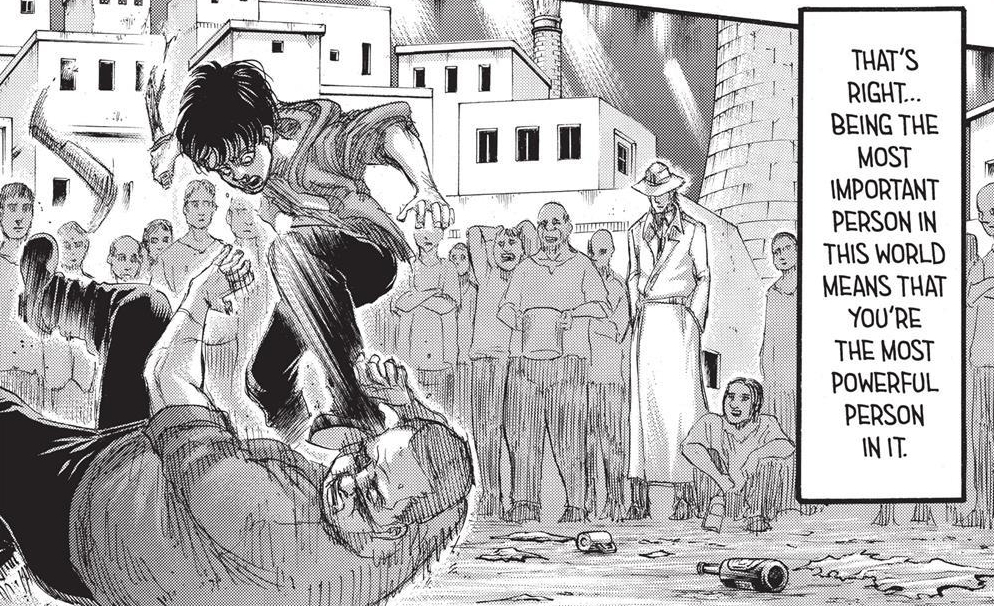
The sad irony of Kenny’s dream is that the power he wanted so badly had always been a lie. Uri’s “kindness” was a sham. Karl Fritz’s ideology made him oppress his subjects, and the paradise he wanted to build could never thrive with an outside world preparing to attack it in only a few years. Even if Kenny had found a way to successfully steal the Founding Titan, it would have been pointless; Ackermans can’t even become Titans to begin with.
Of course, Kenny’s chance at becoming a good person had always been there; Levi. Kenny gave up on properly raising Levi, giving in to his self-hatred and burning desire to achieve his dream. Even when offered by Rod Reiss a chance to forgo his service and live his remaining years in peace, he refused it. The blood on Kenny’s jacket was stained too deep in the fabric to ever be scrubbed out.
And in the end, what did that grand dream earn him? He lost everything. His squad, his dream, his life. The power he coveted was always out of his grasp.
On death’s door, and reflecting on his life, however, Kenny came to an epiphany. He had initially misinterpreted Uri’s mercy as a show of power that granted him the luxury of kindness. Learning firsthand just how futile his efforts had been made him realize what it really was- an act of genuine compassion. He finally realized why Uri chose to spare him that day, and that everyone he had met throughout his bleak and bitter existence had been drunk on their desires and dreams, just so they’d have the strength to live. They were all slaves to something, even when those things destroyed them. Even Uri. This realization is what moved him to make the last decision of his life.
In what could be described as his one true act of kindness, Kenny gave the serum to Levi, the same person he had abandoned all those years ago, and died shortly after. By letting go of his dream, Kenny passed the torch of kindness that had been shared with him when he was spared by Uri to Levi, and finally became the compassionate person he had always wanted to be in his final moments.

Understanding Kenny as a character is all well and good, but understanding what makes him significant to the themes of the story is just as important.
Kenny’s relevancy as a character is somewhat unconventional. He remains irrelevant to the plot for most of the story, but is integral to the narrative for its entire duration; so much so that once you notice it, it is impossible to ignore. Again, my distinction between the two is the events of the story, versus what Isayama is trying to say through the story.
Kenny’s ghost lingers and haunts the remainder of the story, despite not being literally there. His life and death embody many of the themes of AoT, but they are also a reflection of many of the characters, and there is no better character that encapsulates this than the main protagonist and antagonist himself, Eren Jaeger.
At first glance, Kenny and Eren don’t seem to have much in common. They serve completely different roles in the story; Kenny is one of the primary antagonists of only one arc in the entire story, while Eren is the main protagonist(and antagonist from the Marley arc onwards)of them all, made even less noticeable due to the minimal screen time together that they share. However, I believe that this is not the case. I would go so far as to say that in many ways, their stories are almost identical, and their thematic connection is key to understanding Eren, the ending, and more specifically, Eren’s ending. It’s no coincidence that chapter 69, the chapter that covers Kenny’s life and death and the motivation behind his actions, was republished alongside the final chapter of Attack on Titan, nor is it a coincidence that Eren and Armin’s designs are similar to Kenny and Uri’s.
- Anyone Who Saw Those Things Would Be the Freest Person in the World
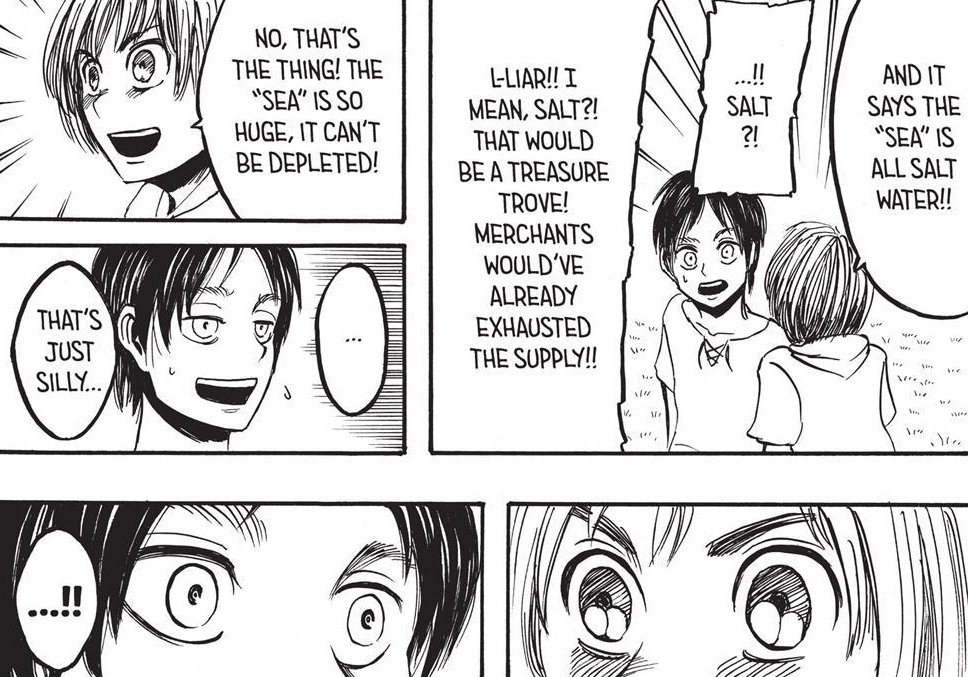
There once was a boy, an average and unspecial boy who aimlessly watched clouds all day, blissfully unaware of what lay beyond the Walls. There’s nothing strange about a younger child who doesn’t think about much, but suffice it to say, he was bored.
But everything changed when Armin came running, a book clutched tightly to his chest.
When Armin showed Eren his book about the outside world, he described a world full of wonder and beauty, a world just begging to be explored by the both of them one day. The look in Armin’s eyes and the description of a world beyond the walls awoke Eren’s dormant desire for freedom, a part of him since birth, but dormant nonetheless. What separated Armin and Eren though, is the difference between what their shared dream of the outside world caused them to see. Whereas Armin saw possibility, Eren only saw limitations. He was angry that the Titans had stolen his freedom, and saw no wonder or joy like Armin did. And that anger was what woke up the monster in Eren, not a monster that he became, but the one that was a part of him all along.
Kenny and Eren both had a narrow worldview that prevented them from seeing the bigger picture. They wanted things they didn’t truly understand, and they paid the price for it. Freedom and power without responsibility will only lead to suffering, and any reader of Attack on Titan knows just how much suffering these two characters inflict. They hated themselves for how they lived, drunk on their ambition yet painfully aware of what they lacked the entire time.
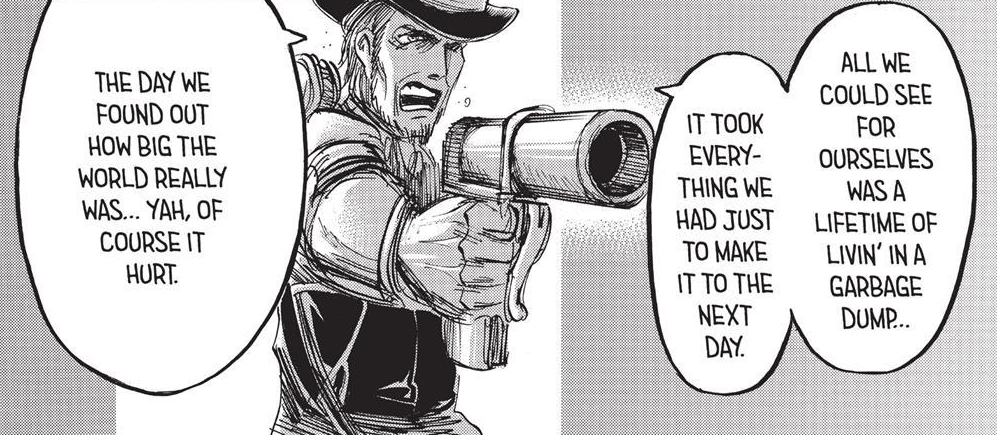

Kenny wanted to see what Uri saw, and what allowed him to be such a “kind” person. Despite this, Kenny’s cruelty only increased after becoming a hitman for the royal government. His role simply switched from killing MP’s to killing Scouts and civilians who knew more than they were supposed to. Kenny may have realized the futility of his lust for power and committed one act of kindness, but it wasn’t until moments before his death.
Replace power or compassion with freedom, and much of Eren’s life was the same. The look in Armin’s eyes was nothing more than a bitter reminder that he wasn’t free, and while Armin had an awesome dream, he had nothing.
But did Eren ever really achieve freedom? Kidnapped in almost every arc before the timeskip, he regularly needs his allies to save him, along with a recurring motif of him in chains and behind bars that permeates the entire story. Upon reaching the ocean, the place that represented the promised freedom he had yearned for ever since he was a child, he did not feel the catharsis or joy that Armin and his friends felt. Only disappointment that the outside world he had dreamed of had always been a lie, and his future memories had shown an oncoming disaster he could never avoid, because it was a disaster Eren wanted to happen.
Even after the timeskip, Eren requires his friends to come to his rescue in Marley. Eren is still a slave, but now he holds himself hostage, a symbolic representation of his role in the story going forward.
While Kenny’s worldview may not have changed much throughout his life, Eren did grow as a person, recognizing that not everyone outside the Walls were his enemies, and everyone on both sides of the sea and both sides of the Walls were fundamentally the same. He knew the Rumbling was wrong and not his only option, and he hated himself for it. But no amount of personal growth could ever stop Eren’s violent true nature buried deep inside him. Eren was always someone who would prioritize his own personal freedom over anyone or anything else. He rejected his growth for his childish and selfish fantasy of a nonexistent freedom. Eren’s goal of wiping out all his enemies had simply switched from Titans to people.
Even if he had completed the Rumbling, I’m sure he never would have been satisfied with the empty wasteland of a world outside Paradis, devoid of life or purpose and even further from the world described in Armin’s book. His boredom with life before he learned about the outside world as a child would have only returned.
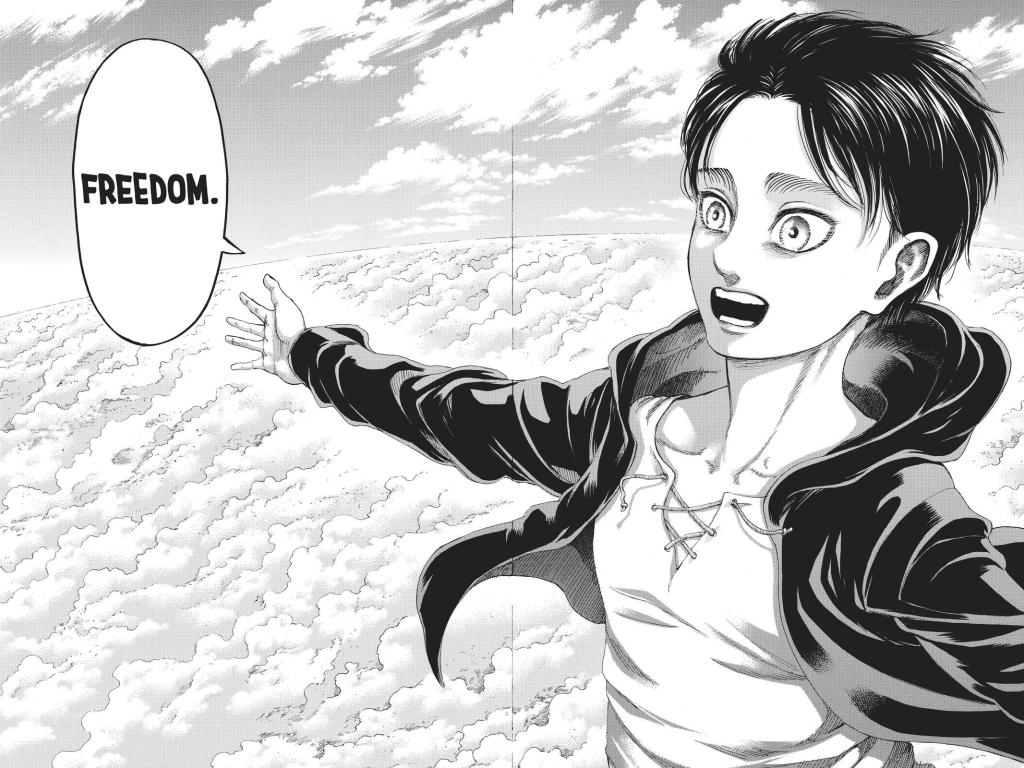
Even during the Rumbling, at Eren’s supposedly most free moment, he was surrounded by the same Wall Titans that trapped him as a child and the clouds he was soaring above weren’t even clouds, they were titan steam. A fleeting illusion, and the walls that confined him were still there.
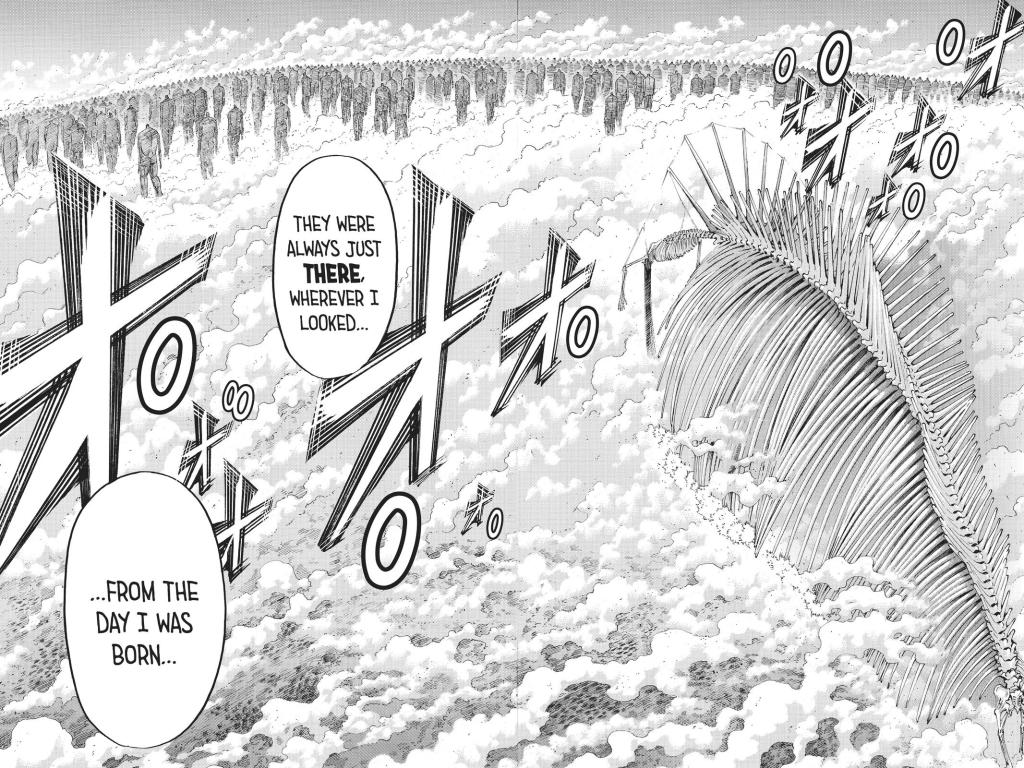
Kenny’s self-hatred led him to abandon Levi and pursue his path of violence, and Eren’s decision to push his friends away was the same. He loved his friends, and wanted them out of the picture so he could destroy the world(partially) for their sake.
But however genuine his care for them was, he still did nothing to consider their feelings, and instead chose to bear all his burdens alone, leaving them behind without any consideration for the consequences of his actions.
The difference between him and his friends, specifically Armin and Mikasa, is important to understanding the biggest difference between him and Kenny. Kenny was able to let go of his dream, and you could say that he found freedom in his final moments because of it. Eren, on the other hand, was never able to let go of his dream, and forced that decision on someone else, that someone being Mikasa.
There are multiple instances throughout the story of Eren doing things like this. Eren always had feelings for Mikasa, but rather than confessing himself he forced her to confess to him, asking what he meant to her even when it was obvious to someone as affection-starved as Zeke. Later on, upon learning she would make a choice that would erase the power of the Titans from the world, he accepted it without even knowing what that choice would be.
He gaslights Historia to defuse her opposition to his genocide, guilt tripping her over her choice to save him in the underground chapel. He refuses to stop the Rumbling, even when his friends make the argument that Paradis would already be safe for centuries if he stopped.
When Armin was on the brink of death after sacrificing himself to take down Bertolt, Eren was able to accept his death- until discovering he was still alive.
Foreshadowing their choices in the ending, Mikasa and Armin are able to let go, while Eren cannot. Armin puts Eren before his dream of seeing the outside world, and gives it up to give him a chance at stopping Bertolt. At first, Mikasa protests as much as Eren does, wanting Armin to survive above all else. But after Hange’s words give her a chance to reflect on her relationship with Armin and the situation they’re in, she stops resisting and chooses to let him go.
Eren on the other hand has to be physically restrained by Floch, having someone else make the choice for him.

Eren is not a character who can make hard decisions if it means personally giving up something or someone he cares about. Armin and Mikasa were always people who could let go of the things that mattered to them, when the time came for them to make that choice; Thus they would always come into conflict with Eren, as making compromises, no matter how reasonable or unreasonable, was something he could never do.
The alternate, false reality he creates in Paths is an encapsulation of his mentality. He asks Mikasa to forget about him, wanting her to live a happy life without him, hoping she’ll just quietly accept it, while doing nothing to consider her feelings or the pain he causes her. His waffling in the final chapter is nothing more than a convenient excuse, that it was all for his friends, despite getting 2 of them killed, despite admitting in the same conversation later on that regardless of whether or not his friends tried to stop him, he still would have done it anyway and that he wanted to do it. He was incapable of making the simple choice to be with his friends, even though it was all they ever wanted from him.
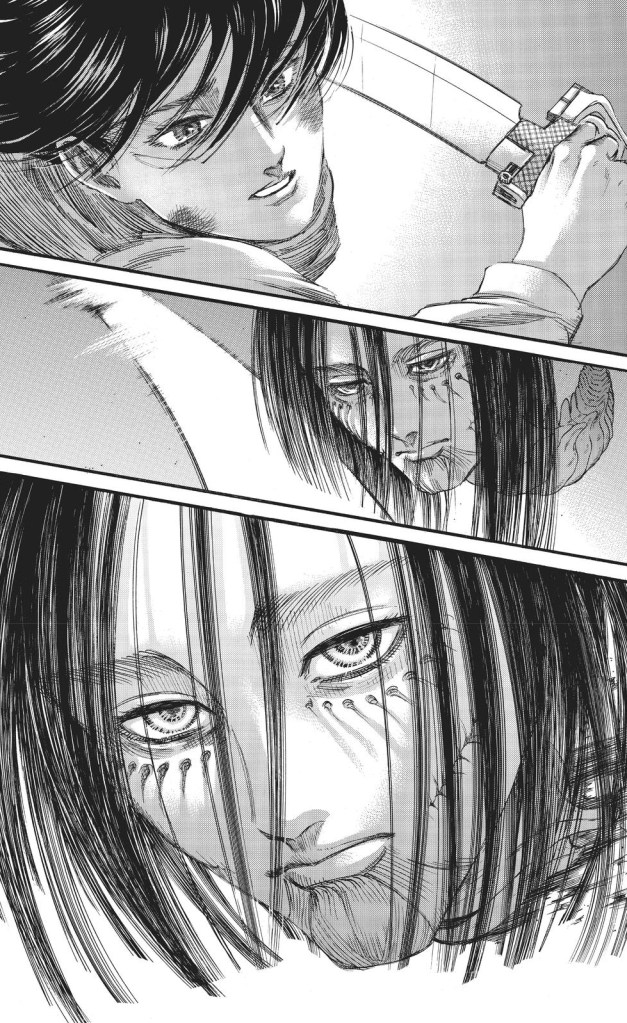
Ultimately, Eren was not only unable to let go of his dream; he was unable to let go of the idealized image of freedom, Mikasa, and his friends that existed in his head. The world wasn’t the way he wanted it to be and he couldn’t compromise with that in any way. His desire for personal freedom far outweighed the safety, agency or feelings of the people he was supposedly protecting. And in the end, he was killed by Mikasa, someone who was able to let go of what she cared about the most, while he could not. He was killed by the very “freedom” he could never accept that he had.
- The World The Girl Saw


There is one more character that I think matters most regarding Kenny’s thematic connection to the ending, that character being the founder herself, Ymir. While her connection to Kenny is even less immediately obvious than Eren’s, it is just as significant. I would even go so far as to say that without an understanding of it, both Ymir’s character and her role in the ending will not make sense at all.
All of her characterization comes from visual storytelling and dialogue spoken to or about her, as she does not speak at any point in the story. As such, her arc is more abstract and interpretable than any other. Though it takes some inference, I believe her arc still maintains a rich exploration of the themes I previously covered, as well as being a solid character in her own right.
When Ymir’s village was burned down, her parents killed, and her tongue cut out, her freedom and dignity were stolen from her. Freshly enslaved by a worthless bastard, she lost everything in less than a day without even knowing why. In a situation that bleak, anyone would latch on to whatever small hope they were offered, regardless of whether or not that hope was false. And what better to latch on to in despair, than love?
The loss of her parents likely fed her loneliness, but where her feelings originated is irrelevant. What matters is that Ymir yearned for connection, though she was too young to really understand it, and witnessing a marriage after becoming a slave shaped her mindset even further. I’m sure that marriage, or some kind of physical union between two people, was all she thought there was to love, as a child who had yet to experience it. It’s similar to when Kenny first witnessed Uri’s kindness, or when Armin showed Eren his book about the outside world. Kenny wanted to see what Uri saw, and Eren wanted to see what Armin saw; Ymir wanted to see what the married couple saw. These characters were all given a simplistic view of something they wanted but didn’t understand, these moments acting as catalysts for the destructive lives they would all eventually lead.
But connection was not all that Ymir desired. Knowing what it was like to be robbed of freedom, she freed a pig from its pen, not realizing that domesticated animals can’t survive in the wild. She would soon learn just how steep the price of freedom can be.
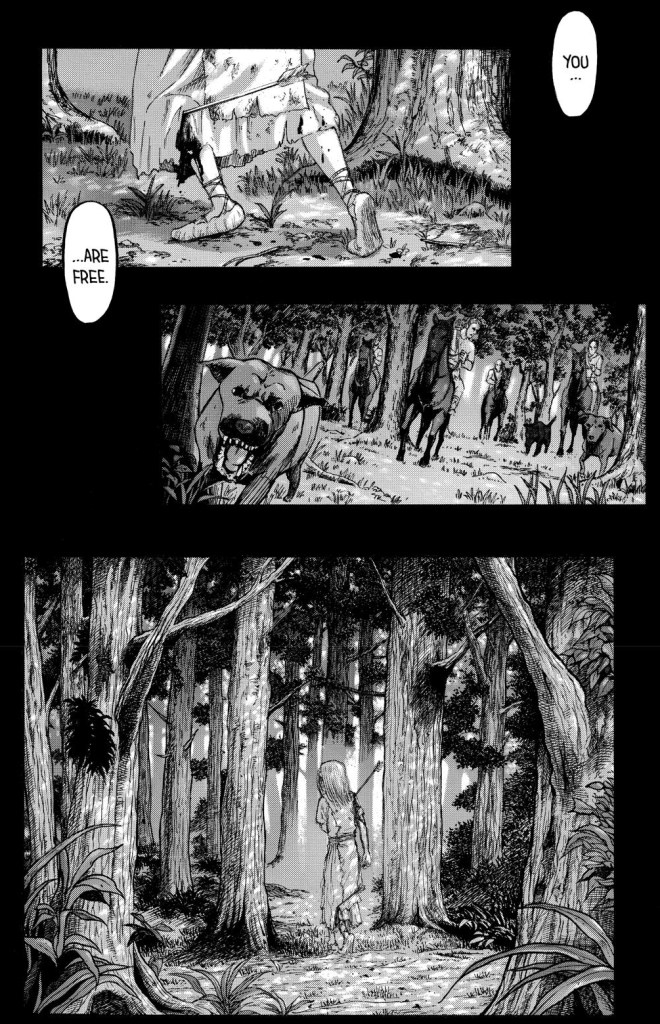
The moment when Fritz sent his men and his dogs to hunt Ymir in the forest planted a seed in her mind; This is freedom, and to be free is worse than slavery.
Extreme circumstances aside, it’s true to an extent that freedom is painful. True freedom is painful, because to be truly free is to truly understand all of the freedoms you lack. Of course, Ymir could never process her abuse in such a way. She was a child with arrows sticking out of her limbs and flesh-hungry dogs closing in, how could she think of anything beyond survival?
Ymir would realize one day what it meant to be truly free, but not until it was too late, not for another 2,000 years…
After becoming the first Titan, Ymir returned to Fritz and accepted his abuse, viewing it as “love”, twisted as it is. We as the audience know that Fritz’s treatment of Ymir is wrong, but her young and impressionable mind caused her to view her suffering as a privilege, giving her tunnel vision that prevented her from considering other ways of using her power. Ymir’s desire for connection, for some kind of affection was taken advantage of, and she was used by Fritz to further expand his tribe into an empire. With her parents dead and her village in ashes, she had nowhere else to return to, and the trauma of being hunted in the forest had convinced her freedom was worse than slavery.
After proving her worth to Fritz, he “rewarded” Ymir with the right to bear his children, which manipulated her due to her childish perception of love. Despite believing she had earned his love, nothing had changed since before she gained godlike power, and she remained an unloved slave even beyond the death of her physical body.
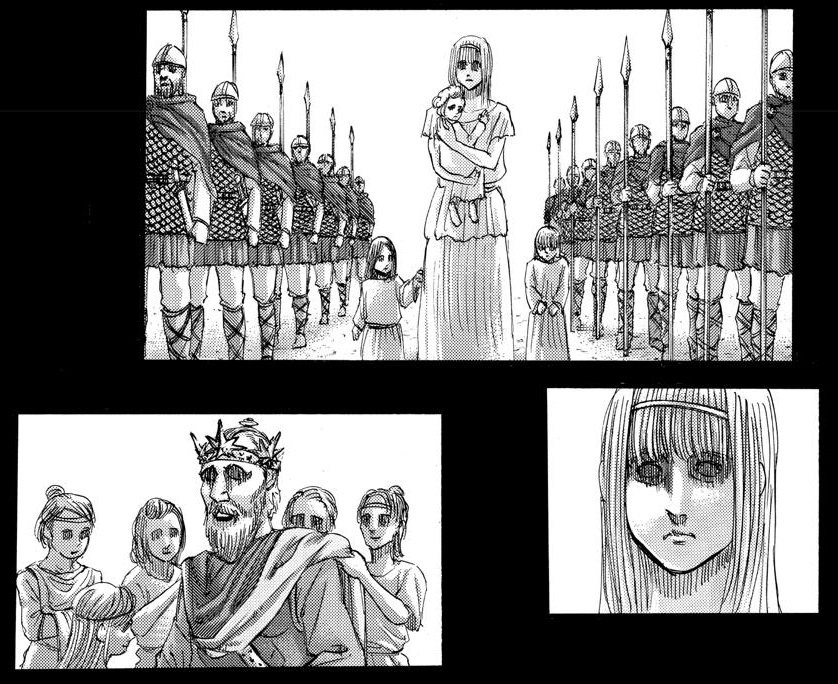
The unfortunate misconception that the ending romanticizes Ymir’s abuse is wrong; The story acknowledges that Ymir suffered immensely and her love was toxic. But she was a child who didn’t know any better, a slave not just to Fritz’s will, but to her own mind and trauma, and she never had anyone to support her or tell her what she was going through was abuse. Literally and metaphorically silenced, she was never able to tell her own story, the details of her life twisted and altered to conveniently suit Marleyan and Eldian propaganda.
It’s no coincidence that Ymir retains her child body when she is portrayed in Paths, despite dying as an adult. The Paths dimension represents Ymir’s body and mind, hence the resemblance to a central nervous system. This detail clues us in on Ymir’s view of herself; The same subservient child who longed for external validation, just to push forward in a harsh and trying world.
Kenny was drunk on his pursuit of power, and Eren was drunk on his pursuit of freedom. Ymir was drunk on her pursuit of Fritz’s love. Everyone is a slave to something, and Ymir was a slave to her love, even as it destroyed her.

Yet someone did eventually learn Ymir’s story- Eren. Possibly the first person to ever empathize with her, he allowed her to make her first choice truly for herself and let out millennia of pent up anguish and rage. He validated her pain and loneliness, though his words are(intentionally or unintentionally) quite manipulative in hindsight, since everything he says is exactly what she wanted to hear.
However, whatever freedom Eren granted her in this moment is temporary. Her role switches from serving Fritz to serving Eren, continuing to create Titans to prevent the alliance from stopping his Rumbling. She even continues to do so for the alliance’s Titan shifters, as Eren’s will is to allow them their freedom to oppose him.
In the end, the two characters to truly free Ymir are Armin and Mikasa. While Armin’s role in freeing Ymir isn’t as obvious as Mikasa’s, it’s just as important for understanding why she chose to let go of Fritz in the ending.

Zeke’s nihilistic speech in chapter 137 is very similar to the kinds of thoughts we can infer that Ymir is having- that life doesn’t have any inherent meaning or purpose outside of reproduction, and that death is true freedom from the burdens of life. His lines about manipulation for the sake of endless growth are reminiscent of Fritz’s use of Ymir as a tool to expand his empire.
However, Armin can’t agree. He protests that even if life only exists for the sake of propagating more life, there’s still worth and beauty in little ordinary moments and small personal victories that people earn for themselves, regardless of whether or not they’re needed for growth. That just living and enjoying life can be enough.

Considering her connection to the memories of all Eldians, I don’t think it’s a stretch to say that Ymir was able to witness Armin’s precious memories while he described them. Armin’s words reignited the dormant attachment she had to the world she left behind- namely, her children.
Whereas Eren gave Ymir a platform to realize and release her untapped reservoirs of anger at the world, Armin helped her remember and/or realize her love for her children. That amidst all her suffering and manipulation, they were her source of comfort, and whatever trivial moments she spent with them were actually incredibly precious in hindsight. This change in mindset allows her to reevaluate her decisions up until this point, making her choices in the ending come more naturally to her character and the story.

Therefore, Ymir shared control of Paths like she did with Eren, allowing the dead shifters to temporarily reclaim their Titan bodies to stop the Rumbling. Armin’s idealism helped her remember her desire for connection, the desire that created Paths in the first place, and let go of her rage at the world and humanity.
Mikasa’s choice is a rejection of the mistakes of Kenny, Eren and Ymir. The latter characters were consumed by their desires, while Mikasa was able to let go of hers before it was too late.
To her, the world was cruel yet beautiful, and Eren represented the beauty that saved her in her darkest moment, someone who filled in the emotional gap left by the murder of her parents. But due to his excessive violence in Marley and cruel verbal abuse, Mikasa had begun to reevaluate her relationship with him, questioning whether or not this monstrous side of him had always been a part of him. This part is important, because it heavily relates to Ymir’s aforementioned change in mindset. Witnessing Mikasa’s life experiences gave her a previously unavailable opportunity to question her devotion to Fritz. It may seem obvious to us as the audience, but Ymir is someone who until this point hasn’t had a single person to relate to or tell her her love was toxic. Mikasa’s realization that Eren had always been someone who could only see the cruelty of the world, and could no longer be reasoned with was the push Ymir needed to make her choice.
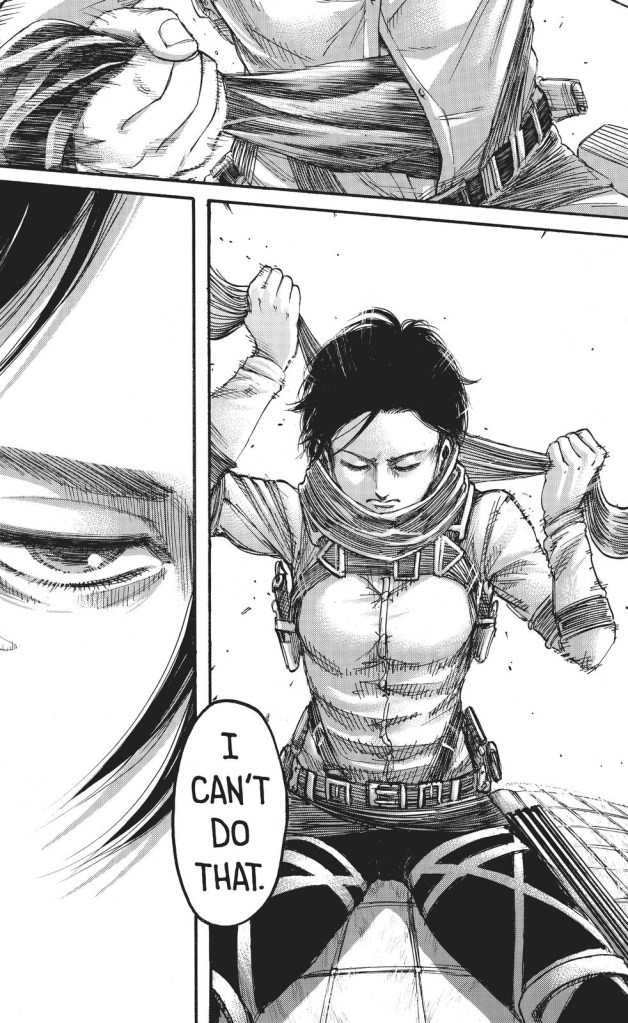
So, Mikasa made the opposite choice of Eren. If Eren’s choice was to remain a selfish child and make other people suffer for the sake of his dream, Mikasa made the choice of selflessness, to grow up beyond the child who loved Eren into the adult who knows that even if you love someone, one day you will have to let them go. And in a sense, Mikasa’s choice to kill him was no different than her past desire to protect him. By killing him, she freed him from his suffering, and protected him from his biggest threat- himself.
Thus serving as inspiration for Ymir to let go of her love for Fritz. Seeing Mikasa break out of a situation she identified with allowed her to finally escape her mental prison and lay the power of the Titans to rest. Her decision to let go is similar to Kenny’s choice to let go of his desire for power. Both chose to forgo their desires in their final moments, finding true freedom from the pain they endured and caused.
Despite all the suffering her power brought, Ymir was still the link between so many people, so many lives, memories and emotions through Paths. Her choice was one born out of a new appreciation for all of the precious lives that had been created because of her- a choice made out of love. This appreciation circles back to her children, the progenitors of those lives. Ymir was never loved by Fritz, but the tears her children shed upon her death make it clear that they were the ones who truly loved her all along.
That’s why I’ve always found the pages detailing Ymir’s passing on after the Power of the Titans is erased such a beautiful and fitting end for her story. Ymir, a character who has lived in a near endless cycle of pain and self-loathing for thousands of years, has finally found peace.
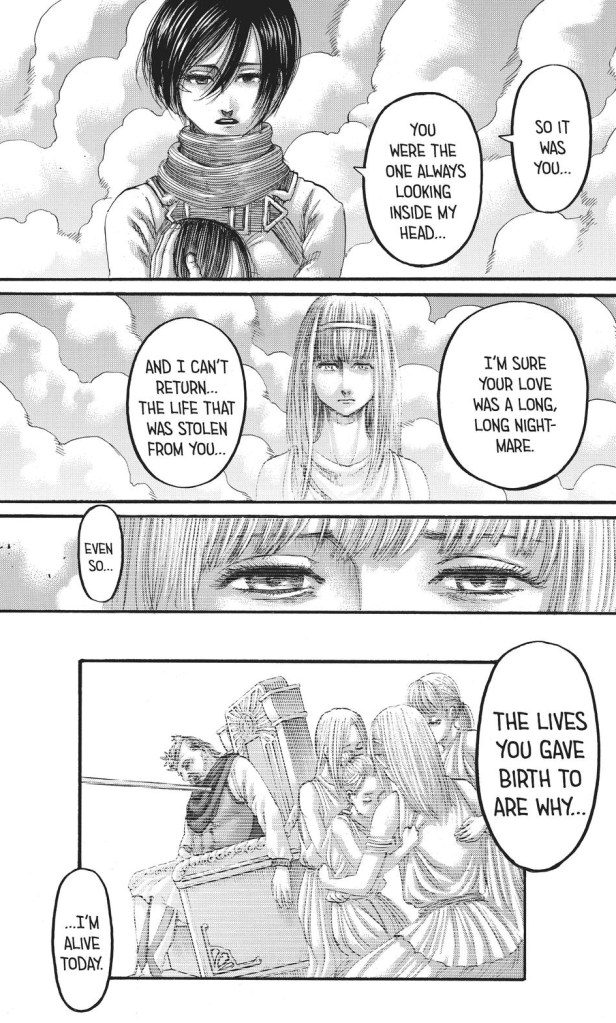
Whereas Eren’s portrayal as a child during the Rumbling was the representation of his refusal to grow up, we see Ymir, eyes unobscured, as an adult. She has overcome her trauma, no longer viewing herself as a child, and let go of her love for King Fritz. The vision of an alternate and impossible reality where she didn’t save him represents the love she regrets not sharing with her children before it was too late, and that she is now fully aware that Fritz was not worth saving. And despite the damage that has already been done, she is finally able to pass on in peace, in the hope that her children, the surviving Eldians, will live on and find hope for a better world. Even after suffering more than anyone else in Attack on Titan, healing, however slim it may have been, was still possible. She’s free.

To summarize:
Due to a combination of their circumstances, natures, and desires, these 3 characters were slaves for most of their lives, with Eren being the biggest slave of them all. They were unable to change themselves or compromise on their goals, perpetuating a cycle of self-loathing and violence that destroyed countless lives.
Each character initially lacked purpose in life, before finding a dream or goal they wanted to pursue. Eren was the boy who sought freedom, Kenny was the man who wanted power, and Ymir was the girl who yearned for love. Yet all three already had what they wanted within their reach.
Eren had his friends, who loved and supported him more than anyone else, and options besides the Rumbling had always been available to him.
Kenny was already powerful due to the Ackerman blood flowing through his veins, and being there for Levi and loving him would have made him as kind as a person can be.
Ymir’s children loved her more than she would ever realize, and staying with them would have earned her more love than a monster like Fritz could ever give.
All 3 had childish ways of viewing the world, failing to realize the nuance of what they desired. Drunk on the pursuit of their goals, they were all slaves to something.
Each had at least one point where a sort of shift occurred, a change in their role that failed to truly bring them closer to what they wanted.
Kenny switched from murdering MP’s to murdering civilians and Scouts that the monarchy wanted gone, ironically becoming an even crueler person in his pursuit of kindness.
Eren switched from killing Titans to humans, his initial goal of wiping out all his enemies remaining largely the same. His “freest” moment is a temporary illusion, as it comes as a result of him failing to overcome his true, violent nature, all the while fulfilling the exact future memories he was initially horrified by.
Ymir had never earned Fritz’s love, even after becoming his concubine. She continued to obey his orders, not realizing she was being abused and her innocence was being taken advantage of.
The 3 were unable to realize their mistakes until it was too late, regretting that they weren’t there for the people they loved in their final moments.
Ymir and Kenny were able to let go, but Eren never could. And in the end, all three were at last freed from their burdens in death.
- That Miracle/Conclusion
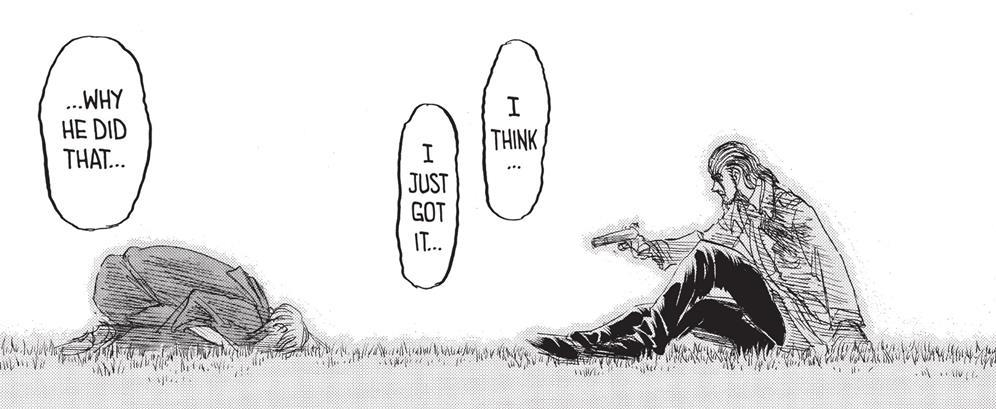
Kenny was not a good person, but his plight is one we can still empathize with. His harsh circumstances forced him into becoming fluent in the language of violence, and the longer you speak just one language, the harder it becomes to learn more.
But is there a point to all this suffering? Were all 3 of these characters doomed from the start? Like with most of the conflicts presented in the story, Attack on Titan does have an answer to all this despair. AoT has never been as nihilistic as people have made it out to be, providing genuine solutions and hope to many of the human problems it examines. There is one moment that I think gives the audience the most direct and definitive answer to the dilemma explored through Kenny, Eren and Ymir- Eren Kruger’s final task for Grisha during the end of the basement flashback.

When Kruger instructed Grisha to love someone inside the Walls, so as to prevent the mistakes of the past from repeating, I’m sure most people initially assumed this referred to the conflict between Eldia and Marley, and that Kruger wanted Grisha to bring an end to the cycle of violence. But I believe there is a different, more in-character reason as to why Kruger would say this. Kruger wanted Grisha to start a family not as a way of ending the Marley/Eldia conflict, but so he would have an emotional anchor to stop him from becoming drunk on his goal of restoring Eldia.
Kruger’s lack of said anchor was what led him to torture and transform thousands of Eldians into Titans, despite intending for the restoration of Eldia. He continued to view his goal with the same narrow worldview he had as a child, the same crack in the closet with no one to remind him of what he was fighting for in the first place. Sound familiar?
Grisha wasn’t much better. His frantic attempts at molding Zeke into the perfect Eldian loyalist and warrior ended in disaster, forcing Zeke into a position where he had no choice but to rat out his parents to save himself, dooming all of the restorationists in the process. Grisha never provided Zeke with the parental love that was all he ever wanted, and Zeke internalized his trauma to such a degree that it shaped him into the monster he would eventually become.
This is why Grisha must love someone within the walls. The same mistakes don’t just refer to the mistakes made throughout the history of Attack on Titan’s world, but also to the mistakes of the characters of AoT and how they bleed out into the larger conflict of the story. Pursuing a mission or a dream, whether it be for yourself or others, without regard for the consequences or a well-developed perspective on what you are pursuing will only lead to suffering. The corruption of your dream will become inevitable. Grisha must remember who he is fighting for to begin with, lest he disregard and hurt the people around him in pursuit of his mission, repeating his and Kruger’s mistakes.
This is the answer to Kenny and all the characters that made the same mistakes as him. Those who were drunk desperately clung to their dreams to seek purpose in a world full of hardship, losing sight of what mattered most in the process. They were slaves to their desires even as they ruined them. But AoT shows us that this was not the only path their lives could have taken. It is absolutely not a coincidence that most of the surviving characters in the ending are people who were able to let go of something they wanted or someone they cared about at some point in the story. Jean, his dream of an easy life. Reiner, his desire for external validation even at the expense of other people. Gabi, her bigotry for the Eldians of Paradis. Levi, Erwin. Connie, his mother, and so on. All had anchors that stopped them from losing themselves in their dreams, able to let go before it was too late.
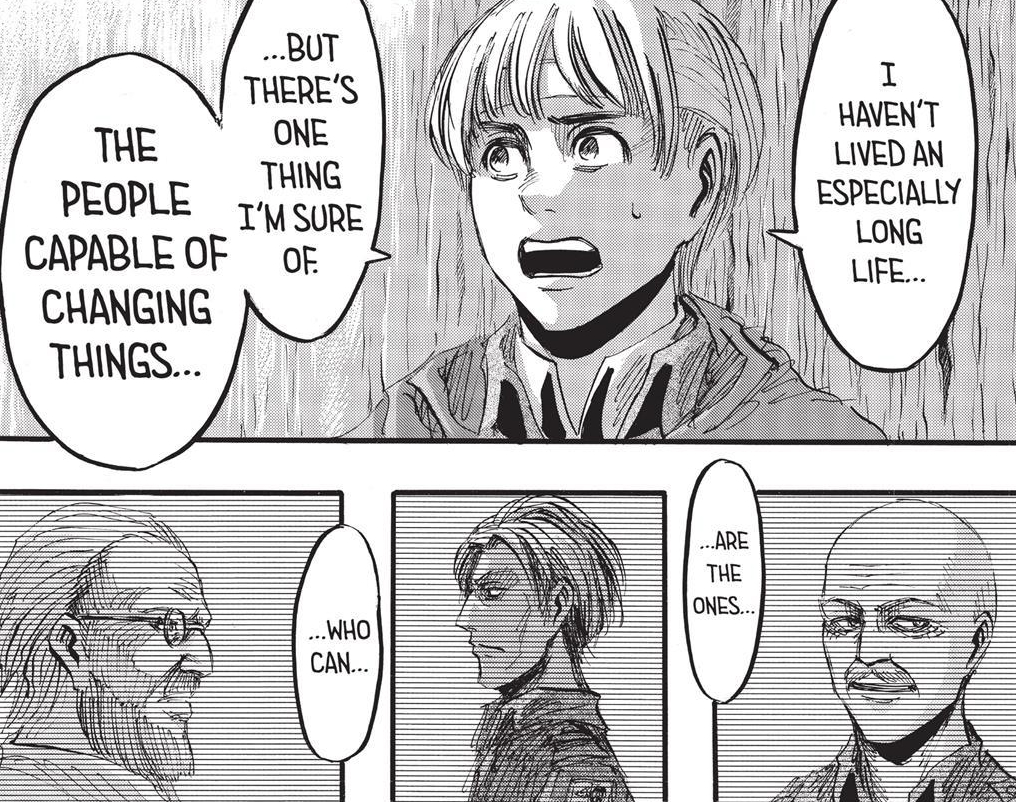
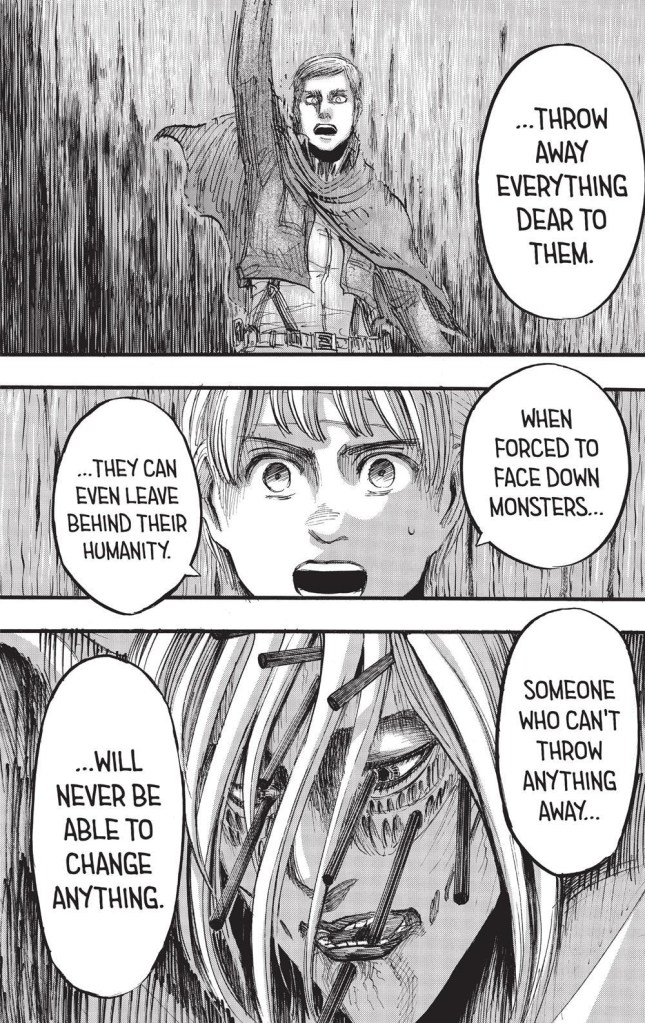
Kenny, Eren and Ymir did not need grand ambitions or external validation for their lives to have meaning. The people who already cared for them and the fact that they existed and lived in the world at all meant they could produce their own value. The little, trivial moments they initially would have scoffed at were far more precious in hindsight, and freedom was never an impossibility.
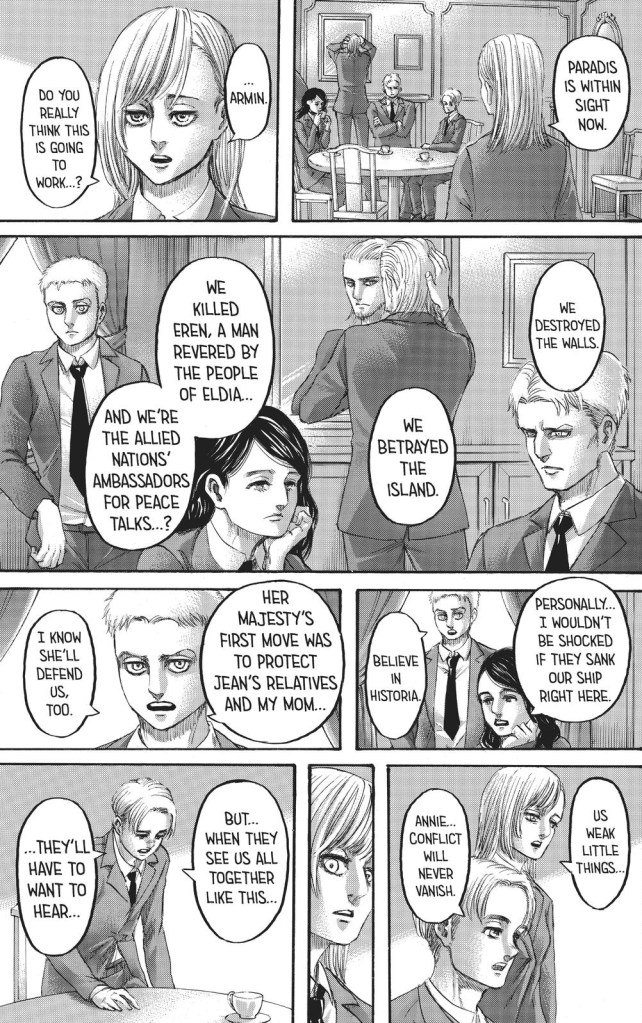
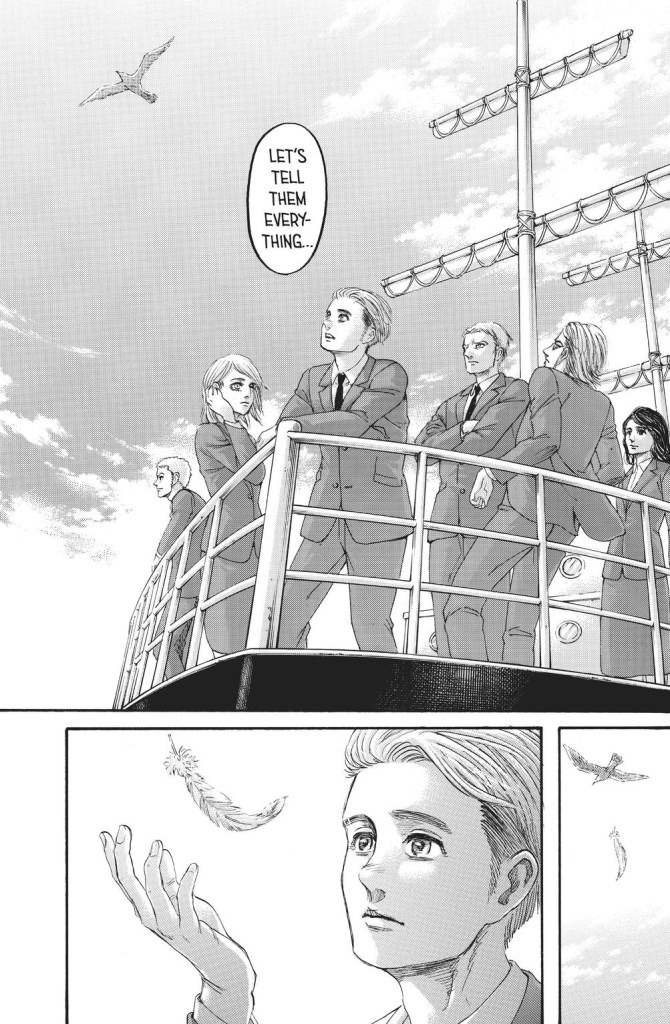
But freedom comes at a cost and those who are freest know they are in a cage. Yet by their freedom, they dictate the terms of that cage, even in the face of a world full of suffering. Violence is an unavoidable truth of the world, and an unavoidable truth of humanity. But letting go of that violence, that desire for progress even at the expense of others, is a necessary step towards becoming better people.
Because maybe, making the choice to let go of something important, whether it be a dream, an instinct, or a desire… is freedom.




 Man of Few Worlds
Leave a reply to Jason Cancel reply